Showing posts with label birth control. Show all posts

September 3, 2020

but the men didn't know

мужики

а мужеги-то и не знали: такое раз но образие

имхо: 

современный феминизм для того и создан — шоп жанчынки воевали между собой, в принципе любое левое течение — теоретично, а правое, отлично от левого, занимается телом.
К примеру, создание пилюли, или метода ритма. Всё это сделали люди, далёкие от левизны.

August 9, 2020

Removal of Sanger’s Name from Her Clinic

Re “Planned Parenthood in N.Y. Disavows Margaret Sanger Over Eugenics” (Washington Post, July 22):Sanger’s 1st clinic at 17 West 16th Street, NYCSanger’s 1st clinic at 17 West 16th Street, NYC

Margaret Sanger pushed her way into the (then) widely respected eugenics movement in order to win greater acceptance for birth control, which was illegal and associated with promiscuity and prostitution. Yet she vehemently opposed the eugenics movement’s principal goal: increasing middle- and upper-class childbearing.

Sanger believed that every woman, regardless of class, religion, or race, should be able to decide when and if to have children. The exception she made, which was broadly supported, was for those who were incapable of caring for a child or were at risk of passing on a disease or defect. Today we see a troubling disconnect between Sanger’s lifelong fight for women’s reproductive freedom and her inability to extend rights and liberties to the mentally and physically disabled.

But it’s important not to let the decision by Planned Parenthood of Greater N.Y. legitimize the accusation made by many on the right that Sanger was a racist intent on limiting the reproduction of people of color. Sanger never defined fitness for parenthood in racial terms and worked closely with Black leaders and in Black communities to improve access to contraception.

Peter Engelman

Conway, Mass.

June 10, 2014

God is dead, or Nietzsche is dead

новый автор MSPP (Madeline Moran) написала хор.пост What Did Sanger See in Nietzsche ?

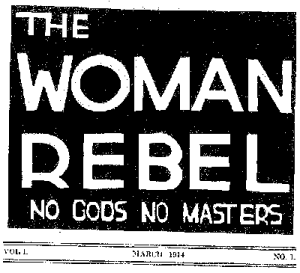
Якобы (см. кортинко) лозунг навеян Ницше:
“No Gods No Masters” was Sanger’s interpretation of a French saying Nietzsche quoted, “Ni dieu ni maître!” (‘Neither God nor master’)
особенно она напирала на аморализм и супермена, которые как бе опрокидывали традиционную мораль (массовую), под которой (непонятно по какой причине) понимаются большие семьи -- осн предмет борьбы МС; а вместо неё пользовали индивидуальну, самопровозглашённую.
тут её обычный приёмчег -- тактический союз с кем попа ло

надо добавить: пробовал читать Так грил Заратустра -- оч не понрави.лось

упг: ещё пара ссылок

May 22, 2014

A Brief History of Birth Control in the U.S.

BY KIRSTEN M.J. THOMPSON | DECEMBER 14, 2013
Prior to modern methods of birth control, women relied on withdrawal or periodic abstinence. These methods often failed.

Around 3000 B.C. Condoms made from such materials as fish bladders, linen sheaths, and animal intestines.

Around 1500 First spermicides introduced which used condoms made from linen cloth sheaths and soaked in a chemical solution and dried before using.

1838 Condoms and diaphragms made from vulcanized rubber.

1873 The Comstock Act passed in the United States prohibiting advertisements, information, and distribution of birth control and allowing the postal service to confiscate birth control sold through the mail.

1916 Margaret Sanger opens first birth control clinic in the United States.  The next year she was deemed guilty of maintaining a public nuisance and sentenced to jail for 30 days. Once released, she re-opened her clinic and continued to persevere through more arrests and prosecutions.

1938 In a case involving Margaret Sanger, a judge lifted the federal ban on birth control, ending the Comstock era. Diaphragms, also known as womb veils, became a popular method of birth control.

1950 While in her 80s, Sanger underwrote the research necessary to create the first human birth control pill. She raised $150,000 for the project.

1960 The first oral contraceptive, Enovid, was approved by the US Food and Drug Administration (FDA) as contraception.

1965 The Supreme Court (in Griswold v. Connecticut) gave married couples the right to use birth control, ruling that it was protected in the Constitution as a right to privacy. However, millions of unmarried women in 26 states were still denied birth control.

1968 FDA approved intrauterine devices (IUDs), bringing early versions like the Lippes Loop and Copper 7 to market.

1970 Feminists challenged the safety of oral contraceptives (the Pill) at well-publicized Congressional hearings. As a result, the formulation of the Pill was changed, and the package insert for prescription drugs came into being.

1972 The Supreme Court (in Baird v. Eisenstadt) legalized birth control for all citizens of this country, irrespective of marital status.

1974 The FDA suspended sale of the Dalkon Shield IUD due to infections and seven documented deaths among users. Although other IUD designs were not implicated, most IUDs were slowly taken off the US market due to the escalating costs of lawsuits in subsequent years.

1980s Pills with low doses of hormones were introduced, along with a new copper IUD, ParaGard (1998). (CuT380a).  Growing awareness of the Yuzpe regimen for emergency contraception.

1990s Introduction of Norplant, the first contraceptive implant (1990),DepoProvera, an injectable method (1992), FC1/Reality, a female condom (1993) and Plan B, and a dedicated emergency contraceptive product (1999).

2000s Rapid expansion in method availability and improvements in safety and effectiveness, including introduction of Mirena, a new levonorgestrel-releasing IUD (2000), Ortho Evra, a hormonal patch (2001), Nuvaring, a vaginal ring (2001), Essure, a method of transcervical female sterilization (2002), Implanon, a single-rod implant (2006), and FC2, an improved female condom (2009).

2002 The first implant, Norplant, is taken off the US market.

2010s Ella, a new emergency contraceptive pill (2010) and Skyla, a new levonorgestrel-releasing IUD (2013) are introduced.  Growing use of the copper IUD for emergency contraception.

2013 After protracted regulatory and legal battles, one brand of emergency contraceptive pill (Plan B One-Step) becomes available without a prescription on drug store shelves.

Today More research is needed on woman-controlled methods that protect against STIs and birth control for men. Barriers to accessing reliable contraception remain for women worldwide.

October 16, 2013

97 years old

"No woman can call herself free who does not control her own body."
97 лет назад, Маргарет Сэнгер открыла в Бруклине (НЙС) первую клинику планирования семьи. Она была арестована через 9 дней, в ходе судебного разбирательства судья сказал ей, что дамам не прилично "право совокупляться с чувством безопасности, что не будет зачатия." ("the right to copulate with a feeling of security that there will be no resulting conception.") Дамы просто не могут вынести такую свободу!

Судья сказал, что он будет мягким, если она клянётся не нарушать закон. Она ответила: "Я не могу уважать закон, в том виде как он существует сегодня". Ей присудили 30-днеей принуд.работ, а жалоба была отклонена. Два года спустя, суд апеляционный суд Нью-Йорка легализовал контрацептивы по рецептам (диафрагмы, презервативы, пояса целомудрия (JK, что на последнем). [JK -- что это такое ?]

Судебный процесс привлёк большое внимание к борьбе Сэнгер за право контролировать рождаемость. В 1921 Сэнгер основала Американскую Лигу контроля над рождаемостью, которая позже превратятся в планируеме родительство [Planned Parenthood].

April 9, 2013

stunt party

Э Рузвелтне знаю как это перевести с английского :(

в оригинале назвaние: Girls Night Out (1933 Style) 

по ссылке описана вечеринка устроенная Элеонор Рузвельт 20 марта 1933 года, через пару недель (4 марта) после того как она стала первой леди США, там же перечислены наиболее известные участницы этого буйства.

Автор также приклеивает сюда лоббирование в конгрессе (сенате, точнее) отмены включения контроля рождаемости в список непристойностей, в частности проекта SS 4436, внесённого пузатым дяденькой на фотке и зобаненого юридическим комитетом.
Senator Henry D. Hatfield
Успех (потом, 1937 году) был достигнкт в верх.суде.

March 30, 2013

Norman Haire, her Australian contemporary

Оказалось, что, как и многие левые деятели, был потомков евреев, выехавших из Восточной Европы, возможно России -- это мы ещё выясним. Родился он как Norman Zions (1892).
Вышла книжка про него, из рецензии на эту книгу он и стал мне известен. В принципе: в каждой стране должен был быть такой человек или небольшая группа, т.наз, лидеров, вокруг которых идеи и практики кристализуются, и движуха кипит.
Был геем, при переезде в Англию (1919) поменял имя по аналогии с именем отца Zajac. В Англии занимался естествоиспытаниями, которые (не его усилиями) привели к созданию виагры. Он купил дом на Harley Street и владел ролсройсом с шофёром, при этом работая в гин.клинике для бедных, которых втих.оря подучивал уклоняться от беременности. Бабло видимо шло от секспросвета (sex sells), на этом поприще он был оч плодовит.
На конфе в Амстердаме (1921) встретил любовь всей свое жизни.
К конц 30х здорвье ухудшилось, развился диабет, и на фоне евробезумия он решил вернуться домой. Домашняя инсулиновая терапия и удалённость войны поправили здоровье, и он стал писать для журнала Woman (ed by ) в качестве Dr Wykeham Terriss (a play on Wickham Terrace, the Brisbane equivalent of London's Harley Street). Много выступал по радио, в частности для американских войск в северной Австралии по поводу вензаболеваний. После войны, последовавшего бебибума и антимальтузанского господства Colina'a Clark'a, оптимистическая книжка которого у меня есть уехал взад в Лондон.
Умер в 1952 году, передав свой архив университету Сиднея. До появления книжки был забыт, патамушта был мужыг, даромшта гей.
Да, забыл: родился в огромной семье, наблюдал свою многодетную мать, проникся и вполне логично стал мальтузианцом.

February 3, 2013

MS mom's puzzle and free BC

образовательный стандарт
Наш ответ ихней рациональности

Сколько же беременностей было у матери МС?

Сведения розняцо, вот б-м свежая статейко хафпоста:
Margaret's own mother had died at the age of 48, her body literally worn out from having 11 children and seven miscarriages.
Тут даже возраст перевран, если прально помню.

Сама статья про открытие клиники, годофщинко.
+ некоторые детали: 1960 - pill approved by FDA, 1965 - легализация контрацепции, 1973 -- абортов
даты надо проверять, ибо истошнег хреноватый, но с этим врятли врёт:
This morning, the Department of Health and Human Services announced new guidance for implementing the birth control benefit of the Affordable Care Act. The proposed regulations released today make clear that women will have access to birth control at no cost, no matter where they work....  These regulations treat birth control like what it is -- basic preventive health care that should be available, just like any other preventive care.
Закавыка, насколько понял в том, что birth control oплачиваецо работодателем, но не всяким -- есть исключения, РПЦМП, к примеру, не оплачивает. Так что, если Вы работаете на РПЦМП (или аналогичную faith based х.з.ш), сношайтесь за свой щёт. И это пральный поцхоц: если ПГМ -- занимайтесь абстиненцией, а по пятницам с особым целомудрием.

+ ссылка на исследование в Миссури: бесплатная контра цепция снижает риск нежедалетльной беременности в пять раз

русский сайт IRS
бонус: феереческая хрень от противной стороны -- чисто поржать

January 20, 2013

Stork Code

спасибо, аист, спасибо, птица
"Кодекс Аиста" обыгрывает модную тему отраслевых кодексов
Кортинко взято с ФБ Дэйвида Дизмора, отражает событие 19 января 1934 года

Проект Пирса (The Pierce Bill) предполагал изменения в закон Комстока (ФЗ 1873 года) -- удаление контрацепцтивов и информации о них из списка "непристойных". Судя по кортико, поправка, по-видимому.  на тот момент была обречена. Несмотря на поддержку Кэтрин Хепберн (мать Одри) и Маргарет Сэнгер.

По словам члена палаты представителей Вальтера Пирса  (демократ из Орегона), реформа необходима, поскольку по штатным и федеральным законам, народ.ам не может ни приобрести контрацептив, ни консцльтацию по применению. Тем не менее, на чорном рынке всё есть, но качество особенно консультаций не гарантировано.

Г-жа  Thomas McGoldrick (the International Federation of Catholic Alumni, как же бес попойщыны:) заявила, что сторонники контроля над рождаемостью  мотивированы коммерческими интересами, а не заботой о здоровьи женщин (числом и частотой беременностей).

Её мнение было поддержано одной из немногих женщин-членов Конгресса. Член палаты Мария Т. Нортон (демократ, Нью-Джерси), сказала: "Миссис Сэнгер может и удастся её коммерческое предприятие, но и в этом случае, Господь поможет детям, чьи чистота души и незамутнённость разума о самых глубоких тайнах жизни, стали целью грубых расчётов и грязных мерзостей, рассылаемых по почте". Ни один из обвинителей Сэнгер не предъявил никаких доказательств коммерческих мотивов Сэнгер.

Представители епископальной, лютеранской, методистов и баптистов конфессий выразили несогласие с поправкой Пирса, но высказались только двое некатолических свидетелей дали показания сегодня: Canon William Sheafe Chase of the International Reform Federation and Dr. Thomas E. Boorde, of the Christian Baptist Ministerial Conference, . Они присоединились к числу своих католических братьев в осуждении контроля над рождаемостью, как противоречащему законам природы и слову Божию.

Как и следовало ожидать, многие врачи свидетельствовали в пользу контрацепции, но несколько членов этой профессии выступили против. Один из них, доктор Говард Этвуд Келли из Университета Джонса Хопкинса, отец девяти детишек, назвал споры о контроле над рождаемостью "непостижимо тяжелыми и противными", подрывающими мораль в университетских кампусах. Американская медицинская ассоциация не выявила своей позиции по этому вопросу.

Хотя перспективы поправки Пирса туманн, её автор считает, что она имеет шанс пройти. Для облегчения озабоченности своих оппонентов в конгрессе, он добавил раздел, признающий право штатов, на собственные версии закона Комстока и продолжение рассматривать распространение контрацепции и информации о ней уголовным преступлением.

Конгресс так ничего и не сообразил с запретами Комстока (до 1971 года). Федеральный апелляционный суд в 1936 году ((U.S. vs. One Package of Japanese Pessaries) постановил что федералы не имеют права запрещать врачам получать контрацептивы почтой и предлагать их пациентам. В 1965 году, Верховный суд признал право на контрацепцию (Griswold).

January 6, 2013

Condom History

February is National Condom Month


Important Moments in Condom History


Condoms have been used for centuries. Since
the 19th century, they have been one of the most popular
methods of contraception in the world. Below you'll find
a few important dates in the history of condoms--click on
a date to learn more.


  • 1564
  • 1605
  • 1700s
  • 1706
  • 1855
  • 1861

Gabriel Fallopius invents a linen sheath and tests it on 1100 men. The goal was to prevent syphilis, which proved successful! Having been found useful for prevention of infection, it was only later that the usefulness of the condom for the prevention of pregnancy was recognized.
The first indication that these devices were used for birth control, rather than disease prevention, is the 1605 theological publication De iustitia et iure (On justice and law) by Catholic theologian Leonardus Lessius, who condemned them as immoral.
In addition to the linen sheaths already used, condoms made from animal intestines became available. However, they were quite expensive and the unfortunate result was that they were often reused.
The first published used of the word appears in the poem "The Scots Answer to a British Vision" by John Hamilton, Lord Belhaven.

The first rubber condom was produced. The earliest rubber condoms had a seam and were as thick as a bicycle inner tube.
The first advertisement for condoms was published in an American newspaper when The New York Times printed an ad for Dr. Power's French Preventatives. In 1873, the Comstock Law made illegal the advertising of any sort of birth control.

  • 1920
  • 1950s
  • 1975
  • 1980s
  • 1993
  • Today
Trojan brand condoms introduced, manufactured by Young’s Rubber of New York. Young's Rubber became the first company to produce a latex condom. Condoms made of latex, also invented in 1920, were both stronger and thinner than their rubber counterparts and also has a longer shelf life.

Two improvements are made to the condom: lubrication (DUREX instroduces the first lubricated condom) and the reservoir tip.
While the National Association of Broadcasters Code of Conduct prohibited condoms ads on televison in the 1960s and 1970s, station KNTV in San Jose broadcast a carry a condom commercial for Trojan in 1975. The first broadcast TV network in this country to air a paid condom
commercial was Fox in 1991.
The emergence of HIV and the AIDS epidemic results in strong encouragement to use condoms. Latex condoms are promoted to prevent infection with HIV.
The U.S. Food and Drug Administration (FDA) approved the female
condom
for use in the US. The female condom is a polyurethane (plastic) pouch that fits inside a woman's vagina.
The U.S. Agency for International Development encourages condom use in developing countries to help solve the "world population crises. Worldwide condom use is expected to continue to grow. One study predicted that developing nations would need 18.6 billion condoms by 2015. Condoms have become an integral part of modern societies.


November 15, 2012

Who is Dorothy Brush ?

Dorothy H. Brush, Planned Parenthood activist, whose wealth came from Charles Francis Brush (1849–1929), who invented the arc lamp for street lights and founded the Brush Electric Company. Draper's version of Planned Parenthood was to pass the Involuntary Sterilization laws in 15 different U.S. States.

November 9, 2012

Kitty Marion

Kitty Marion Selling Birth Control Review
Kitty Marion, sometimes mistaken for Margaret Sanger -- this particular photo, stood on New York street corners for thirteen years (1917-1929), dedicated to selling copies of the Birth Control Review.

By 1929, Marion had become a public figure in New York, just by selling copies of a newspaper.

In a 1936 article in The New Yorker, Marion estimated that she alone sold over 99,000 copies of the Review. (“More Memories,” Birth Control Review [May 1923]; “Biographical Note,” Kitty Marion Papers.)

July 19, 2012

A Tempest in a British Teapot: Sanger’s Moratorium on Babies

Sixty five years ago, in July of 1947, Europe was still reeling from the effects of World War II, with widespread housing shortages due to war destruction, reports of thousands starving, the dislocation of refugees, and massive unemployment barring any quick recovery. The United States feared that political instability in Europe would pave the way for the acceptance of communism, and on June 5, 1947 announced an international aid strategy, known as the Marshall Plan, to prop up the European economy and undercut Soviet influences.

As she boarded a plane for England on June 30, 1947, Margaret Sanger gave her own spin on European redevelopment and recovery, telling reporters:

[Hungry] countries should not have another child for a decade. They should do all in their power to help keep women from having children for that period--until the food and economic situations are adjusted. . . . In this country we have achieved a favorable balance of population and resources. This situation has contributed greatly to the raising of our national standard of living. But it will do us little good if in the end European and Asiatic countries, and some of our possessions, continue to overflow their boundaries, crowd their resources and breed themselves into new famines. Many of them will ultimately breed themselves into another war. For that reason the whole world should be interested in the intelligent limitation of population. (New York Daily News, July 1, 1947).

Sanger's proposition, which she noted "definitely" included England, caused a massive stir as the London Daily Mirror told her to go back to America, as "her proposal would be about as practical as telling the sun to stand still or the tide to turn back." Man-on-the-street polls in both the United States and England ran heavily against her position, some calling it "very foolish and extremely stupid," "so ridiculous that it barely merits discussion," and "perfectly fantastic." One Briton offered "I am afraid this Mrs. Sanger underestimates the--shall we say emotional needs?--that lead to the production of babies." (New York Daily News, July 1, 1947 and Boston Globe, July 4, 1947.)

For her part, Sanger was surprised by the reaction, writing to Mary Compton Johnson, one of her secretaries in New York on July 5:

Never have I needed a helper more than I have since I left LaGuardia. My tossing a challenge at American reporters brought an avalanche on my head in London. The 10 year moratorium on babies! Every paper in London sent reporters to the Savoy (except the Times). I was so weary & tired as I had not slept all night on the plane & as I had no prepared statement on the 10 year moratorium idea. It was the most trying and exhausting experience Id really had. Photos, snaps, movies, the Pathe - Paramount took pictures. The RKO and others wanted me to go to the studios. I refused."

ONE MINUTE NEWS

Clearly Sanger touched a nerve when she included Europeans and especially the British into her definition of "hungry" or "overpopulated" countries. People were used to hearing pundits propose that individual families should only have children when they could afford them, or even that underdeveloped or poor nations should curb their birth rate in order to increase standards of living. But Europe? As a woman interviewed in New York said: "Europe, as a whole is not overpopulated. The people there had no trouble in feeding themselves before the war. Everything has been destroyed and they need just a little help from here and there until they get on their feet." (Daily News, July 1, 1947.)

Sanger had long argued that the only thing that parents could do when they did not have the resources to raise children was to postpone having them until conditions improved, and her suggestion for Europe was little more than that same practical advice, ramped up in scope. Sanger wrote her secretary Florence Rose on July 26 about the over-reaction: "Is England included? Do you mean England? Have you been fed by the press that England is starving? My reply: “Ive only just landed in England you don’t look hungry (to the reporters) but if you are yes England too!!! That set John Bull off & retorted that “Granny Slee better stay home & teach the American G.I.s how to avoid leaving illegitimate children for England girls to work for!!!"

Sanger's main purpose in going to England was to attend a family planning conference, but because of the furor, she decided not to attend. She did work with activists in England to plan the International Congress on Population in Relation to World Resources, held without such ado, a year later in Cheltenham, England.

family limitation

On Monday June 25, the Library of Congress opened an exhibit in Washington on "Books That Shaped America". The exhibit celebrates 88 works that shaped American life and thought, including Margaret Sanger's 1914 pamphlet "Family Limitation", which was a basic instructional manual of basic family planning techniques.

"Of course, it is troublesome to get up to douche, it is also a nuisance to have to trouble about the date of the menstrual period. It seems inartistic and sordid to insert a pessary or a suppository in anticipation of the sexual act. But it is far more sordid to find yourself several years later burdened down with half a dozen unwanted children, helpless, starved, shoddily clothed, dragging at your skirt, yourself a dragged out shadow of the woman you once were."

Read more about "Family Limitation" in this blog post, or read the pamphlet yourself here!

Queen’s Hall Meeting on Constructive Birth Control

One activist, Maude Royden, sent a message of greeting that said

"Every child has a right to be desired before it is conceived, loved before it is born, and provided for while it is helpless. Every mother should have time and health to give the fullest measure of love and care to every child she bears, and to give it without an intolerable strain upon her own vitality. Who will deny these things in theory? Who will not admit that they are so true as to be truisms? And yet the brutal denial of these "truisms" in actual everyday life is seen everywhere, and gives us our terrible infant death-rate, our perhaps still more terrible infant "damage-rate" and a mass of almost inarticulate suffering amongst married women..."


Featured speaker Dr. E Killick Millard implored the audience open up to revolutionary new ideas (ie birth control) that could shape the world for the better:

"Ladies and gentlemen, it is time, high time, that we abandoned old ideas, swept away misapprehension and prejudice; it is high time we abandoned false sentimentality and faced facts as they really are. Now, we know, or we ought to know, that means do exist for preventing concpetion and restraining excessive fertility without the mutilation of marriage or the placing of an intolerable and entirely unnatural strain upon married couples. I submit that the experience of vast number of intelligent and thinking people who have used these mean has demonstrated that they are on the whole effective and harmless. I do not think that we can overestimate the fundamental and far-reaching importance of this great question. This question of birth control really underlies so many other great questions of the day. The whole welfare of humanity may be said without exaggeration to be bound up with it."


The London Family Planning Summit: 1921/2012

December 15, 2011

Birth control does not mean abortion

By George J. Marlin Wednesday, 14 December 2011

Excerpt:
Yet despite her harangues against the Church and her insistence that “for the welfare of children, for the happiness of husbands and wives, and for the full realization of Women’s rights, birth control by scientific methods of contraception [should] properly and wisely be exercised,” she did make one exception to an otherwise thorough pro-choice agenda: abortion.

That’s right. Margaret Sanger actually stated that: “Birth control does not mean abortion.” Here are her exact words:

“The real alternative to birth control is abortion,” wrote Dean Inge, [Dean of St. Paul’s Cathedral, London]. It is an alternative that I cannot too strongly condemn. Although abortion may be resorted to in order to save the life of the mother, the practice of it merely for limitation of offspring is dangerous and vicious. [Emphasis added] I bring up the subject here only because some ill-informed persons have the notion that when we speak of birth control we include abortion as a method. We certainly do not. Abortion destroys the already fertilized ovum or the embryo; contraception, as I have carefully explained, prevents the fertilizing of the ovum by keeping the male cells away. Thus it prevents the beginning of life.

I bet you never heard that Sanger considered abortion “dangerous and vicious.” You can take it to the bank that there are no posters hanging on the walls of Planned Parenthood clinics quoting those particular words of the founder.

Margaret Sanger actually believed that abortion destroys an innocent life because she was honest enough to recognize that life begins at the moment of conception (without reference). Hence, she would have disagreed with the U.S. Supreme Court’s conclusion in Roe v. Wade.

the rest

November 20, 2011

July 27, 2011

Eugenic Legacy: The Control of Female Fertility

Margaret Sanger's Eugenic Legacy: The Control of Female FertilityMargaret Sanger, the American birth-control and population-control advocate who founded Planned Parenthood, stands like a giant among her contemporaries. With her dominating yet winning personality, she helped generate shifts of opinion on issues that were not even publicly discussed prior to her activism, while her leadership was arguably the single most important factor in achieving social and legislative victories that set the parameters for today’s political discussion of family-planning funding, population-control aid, and even sex education.

source

April 24, 2011

Planned Parenthood Predates the Pill

Easter_eggs1
by  Marina Adshade
 
It is impossible for me to think about Easter without thinking about estrus – the peak of female sexuality that takes place when a woman is most fertile. It should be our favourite time of the month and it is good that we honour that every year with this excellent weekend in celebration of fertility. Hard boiled eggs, chicks, bunnies are not things that I think about mid-cycle, but for those who are trying to reproduce (as opposed to desperately trying not to reproduce) these are apt symbols.
So Easter is a good time to talk about fertility, a subject that has fascinated economists ever since Malthus pointed out in the 1780’s that breeding like rabbits was not in the best interests of humanity. As most of us know, fertility is currently at an extremely low level with most of the developed world countries, and in some of the developing world countries, people are not having enough children to sustain the population. What you may not know though is that this fall in fertility is not the result of the introduction of the birth control pill in the 1960’s, but is rather the continuation of a trend that began 200 years ago – before contraceptives were even available.
Before we begin, here is a brief history of contraceptive technology. Before the cervical cap introduced around 1838 there was no real technology that could be used to prevent pregnancy. Sure, Casanova was rumoured to have encouraged the use of hollowed out lemons to prevent pregnancy but I can’t imagine that many woman thought that was a “fun idea”. In the 1850’s, thanks to the efforts of Charles Goodyear to vulcanize rubber, condoms became available that were fairly inexpensive and effective at preventing pregnancy. Diaphragms went on the market in 1882 followed by the IUD in 1909. The queen of all birth control was invented in the early 1950’s but didn’t become legally available in the US until the mid-1960’s and only then thanks to the tireless efforts of Margaret Sanger who fought to have oral contraceptives legalized.
Why this timeline is interesting is that fertility began to decline around 1800, long before contraceptives became available. In the US, for example, fertility fell every decade between 1800 and the beginning of the baby-boom at the end of the 1930’s; from seven children per woman in 1800 to two children per woman in 1940. European countries experienced similar declining fertilities with France, surprisingly, leading the pack. (Ironically, France is a modern poster child for how government policy can effectively be used to raise fertility rates)
So how did women accomplish this decline in fertility without contraceptives? First of all they delayed getting married until their mid to late twenties, cutting their reproductive years short, or didn’t marry at all. They practised colitis interruptus which, when faced with few alternatives, is surprisingly effective. Means for abortions were available and widely used as was infanticide. Sodomy and intercourse without ejaculation were also used to control fertility but these methods were apparently more popular within prostitution than within marriage.
What makes this an economic story is that all of these fertility control methods were available pre-1800 meaning that families in the past could have controlled their fertility more effectively – they didn’t need to wait for the availability of contraceptives – but they chose not to. It is when the Industrial Revolution arrived with increased urbanization, reduced agricultural employment and higher wages for educated workers that families began to reduce their size in response to these economic changes.
Contraceptives when seen in this light are not the catalyst for social change and family sizes are not smaller today because contraceptives are available. Contraceptives are available because people wanted smaller families and contraceptives made it possible to achieve that goal at a lower cost. The fact that the expected number of children born per woman in her child-bearing years in the US today is almost exactly the same level today as it was in the mid-1930’s demonstrates that achieving the current level of fertility was possible even without the birth control pill.
Murphy, Tommy (2010). “Old Habits Die Hard (Sometimes): Can département heterogeneity tell us something about the French fertility decline?” Università Bocconi Working Paper 364.
Greenwood, Jeremy and Ananth Seshadri (2002). “The U.S. Demographic Transition” American Economic Review, vol. 92(2) pages 153-159.

Source

March 22, 2011

Сэнгер и кондом

In an ideal society, no doubt, birth control would become the concern of the man as well as the woman. The hard inescapable fact which we encounter to-day is that man has not only refused any such responsibility, but has individually and collectively sought to prevent woman from obtaining knowledge by which she could assume this responsibility for herself.  She is still in a state of a dependent to-day because her mate has refused to consider her as an individual apart from his needs.  She is still bound because she has in the past left the solution of the problem to him. Having left it to him she finds that instead of rights, she has only such privileges as she has gained by petitioning, coaxing and cozening. Having left it to him, she is exploited, driven and enslaved to his desires.”

(1920 Woman and the New Race pp. 96-97)